
Conservative scepticism threatens Britain’s place in the Eurozone
by David Wynne-Griffith
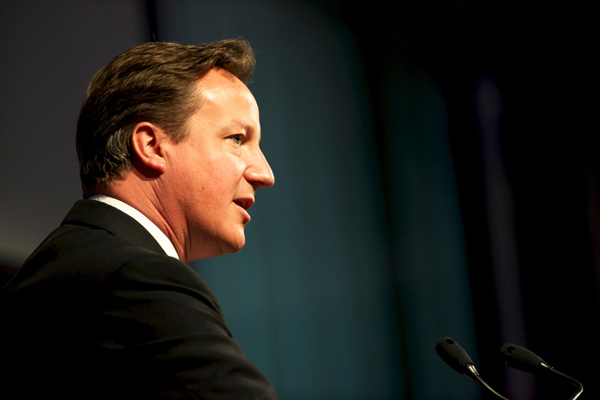
When David Cameron returned from Brussels a few days ago, he must have been feeling a little hard done by. Having attempted to shake some much-needed initiative into the unfathomable dithering of Eurozone leaders in the face of the enduring sovereign debt crisis, he was greeted on his return to a domestic parliamentary party threatening to whip the political carpet from underneath his feet, just when he most needed their support.
Mr. Cameron must have thought that the only verbal barrage he would be taking would be from a ruffled and sleep deprived Sarkozy, lamenting that Britain was deserting Europe in its hour of need. Although the embittered French President did reportedly tell the Prime Minister to ‘shut up’, this minor and misguided insult (Sarkozy’s grasp of English is reportedly rather limited) was a picnic compared to what Mr. Cameron faced on his return to Westminster. This consisted of the largest Tory rebellion over Europe since Major’s reign, a potential coup within his own party and the very real threat that Mr. Cameron could be backed into an inescapable corner, with rampant backbenchers in one corner and money-grabbing EU leaders on the other.
Many close to the Prime Minister advised him to ignore the debate on a referendum to leave the European Union altogether, to sweep in under the carpet and pretend that it was so hors de question that it didn’t merit any form of political response. But Cameron knew that this debate fundamentally mattered because the margin of the outcome had two important consequences. Firstly, the degree of trust to which the Prime Minister is held by his own party, and secondly, the extent to which this revolt could plug into domestic public opinion about Europe. The Euro is now, more than ever, a project protected by the political elites, but assaulted by the masses.
However, the recent Tory rebellion poses a threat that goes beyond politics. As I write this from just outside the Assemblé Nationale in Paris, you can almost feel the volatile cocktail of the Entente Cordial turning sour. Europe is on its knees, and Britain seems heading out the back door in a hurry. Whatever happens to the Eurozone, and the indications of the recent deal shows that it may indeed, as John Major recently put it in the Financial Times, ‘drift towards fiscal union and eventually federation’ as leaders agreed to increase Brussels’ remit to intervene in the budget deficits of nation states. Frightening as this may be for some, if Britain does not stand shoulder-to-shoulder with its European partners now, this will not easily be forgotten.
The simple fact of the matter is, whether we like it or not, Europe is the place with which we currently do more than 50 per cent of all our trade across the globe. Our economy is inextricably linked to the prosperity of the Eurozone. If it fails to survive, Britain has nothing to gain, but much to suffer. The price of leaving the EU wouldn’t be an added perk to our temporary economic well-being or even an added flexibility to our freedom of political action, but the exact opposite. Britain would suffer an unquantifiable loss of influence within its closest and most lucrative trade area, and would be cast out onto the estranged limb of global politics assigned to countries that refuse to reject antiquated nationalist instincts in the name of ignorant unilateralism.
It is a rare thing for a politician to have the opportunity to say that he was right and for nobody to be able to contradict him, but that is the surprising position that mainstream Conservatives now find themselves in. Many are itching to have their moment in the sun and use it to build an impregnable wall along the Channel, a reaction that belies irrationality, reckless irresponsibility and a simplistic and short-term way to view the imbroglio gripping the Eurozone. Conversely, Labour is guilty of hypocritical political cowardice as they tread carefully in the hope of seeing the Tories rendered asunder and thus irrelevant, in a re-run of Major’s premiership.
Granted, the Euroskeptics of Major’s yesteryear deserve some plaudits for realistic foresight, and granted, the Eurozone was never built on solid enough fiscal foundations to support its monetary weight. But this is not the time to allow self-congratulatory pats on the back to reverberate into knee-jerk reactions. The only way to preserve the economic stability of the Eurozone is to finish off what it started- tighten the creaking monetary union through further fiscal integration and spark growth to close the gulf in competitiveness between the core and the periphery. Britain can’t afford to simply sit back in fear of a progressive European federal superstate, for should that scenario eventually appear, it will surely be better to befriend it, rather than alienate it.
Cameron is right when he says that the incessant bickering over European debt is having ‘a chilling effect’ on the British economy. Ultimately, our banks are exposed to the corroding debts of imperiled Eurozone states and should the high-octane tensions of the Euro continue, banks will eventually inject customers with the shock of higher interest rates. Mr. Cameron must not bend to his party’s nationalistic bravado, he must defend our country’s regional responsibility, otherwise Major’s empowered ‘bastards’ may just cast Britain out into the cold once and for all.