
The Hobbit: the desolation of a franchise?
By Jonathan Peters
When I was seven years old I went to see The Lord of the Rings: The Fellowship of the Ring at the cinema. It was an experience that inspired a lifelong love of movies in me – three spellbinding hours that completely blew the previous month’s big fantasy release, Harry Potter and the Philosopher’s Stone, out the water. What was so great about it? Battles beyond the scale of anything ever captured on film, with a rousing, memorable score to match. An emotionally complex set of characters caught up in a gripping adventure story. Intensely imagined, breathtaking environments, and rich world creation, where small moments nevertheless hinted at thousands of years of Middle Earth lore.
Fast forward thirteen years, and many of these elements still hold true for The Hobbit films. The art design, as we journey through misty mountains, ancient ruins, treasure hordes, and icy glaciers, is often breathtaking. All three films could be paused at any moment and the level of detail and imagination in the frame would be awe-inspiring. The combat scenes, from the barrel escape in The Desolation of Smaug to the climactic fight that essentially spans the length of The Battle of the Five Armies, are still some of the most technically ambitious in cinema. Gollum is just as captivating in An Unexpected Journey as he is in The Two Towers and Return of the King, whilst new villain Smaug is perhaps more rounded and terrifying than the rarely-glimpsed Sauron in the original trilogy. At the start of the latest film he fulfils his promise to become death, and there is a real sense of vulnerability and exposure as he threatens to overwhelm his human foes.
However, in many ways The Hobbit is an indisputably weaker trilogy than The Lord of the Rings, owing to factors both within and out of its control. LOTR was a cultural touchstone that opened the floodgates for a wave of imitations, to the point where big budget fantasy adaptations are no longer such a rare event at the multiplex. Viewers’ standards have moreover been raised by series’ like Game of Thrones, which provides a darker, harder-edged experience so that it’s now easy to become conscious of the lack of complex political machinations in Tolkien’s universe. You can’t criticise a film for what it doesn’t set out (or need) to do, but whereas LOTR was groundbreaking in its unparalleled realisation of a fantasy universe, The Hobbit reveals a franchise no longer representing the pinnacle of the genre.
The Hobbit is also a dauntingly difficult project to adapt in the wake of the LOTR trilogy. The novel is a more whimsical affair than its sequels, and the quest isn’t quite on the same scale as the world-ending mission to destroy the one ring. However, if Peter Jackson were to make a light children’s movie after the serious, high-stakes drama of the original films, the end product would inevitably prove a disappointment. The result is a sometimes awkward balance between the two, where parts of the novel that were essentially footnotes are magnified (with limited success) to overblown, LOTR-sized levels, but we also get plenty of toilet humour and slapstick, creating some odd tonal shifts.

For example, in The Battle of the Five Armies, an afterthought following the Smaug sequences in Tolkien’s text becomes a Return of the King-style battle, but whilst the solemn speeches and epic swordfights remain, the grit of battles like Helm’s Deep and the Pelennor Fields is absent, as is the sense that anything significant is at stake. Some of the creative decisions are questionable – Legolas’ shield-surfing was an isolated awesome moment in The Two Towers, but here he runs, jumps and flips weightlessly, until the film reaches a point where the choreography feels full-on Matrix. It’s difficult to make the same investment in certain characters when the filmmaking seems more concerned with contriving cool scenarios than building any palpable sense of danger.
Furthermore, the decision to divide one novel into three parts dooms the pacing across the trilogy. As Bilbo himself would say, it feels ‘like butter scraped over too much bread.’ The first film takes forever to leave The Shire, stretching out about fifty pages of source material into something unacceptably long. The narrations at the beginning of Fellowship (Extended Edition) convey a better sense of Hobbit life and culture than the entire first hour of An Unexpected Journey. The momentum picks up halfway through however, and it is mostly sustained by The Desolation of Smaug, but even that film is jarringly episodic, with spectacular set pieces glued together by obvious filler. The Battle of the Five Armies essentially runs out of story after the first act before commencing its climactic battle, which, while visually enthralling, wouldn’t have hurt as a trimmed part of one or two Hobbit movies rather than a film in itself.
The LOTR series may have cut out some fan-favourite material – Saruman in particular is horribly short-changed, his character only given any closure at all in the Return of the King Extended Edition – but on the whole the result was a saga of tighter, more focused films, with a strong set of protagonists at its heart. At the expense of some colourful, but ultimately superfluous characters from the novels, the audience developed a real attachment to the core group of heroes, making the moments of peril especially shocking and impactful. Whereas every member of the LOTR fellowship has a distinct personality and role to play, in The Hobbit the likes of Fili, Dori, Nori, Oin, Gloin, Bifur and Bofur are practically indistinguishable, and despite the staggering length of the films rarely get a chance to shine.

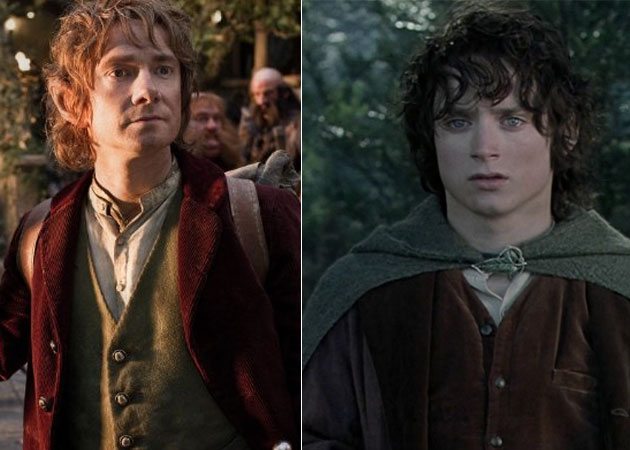
To its credit, by the end of The Battle of the Five Armies Thorin has stepped firmly out of Aragorn’s shadow (a criticism levelled at An Unexpected Journey), his brief corruption by riches and power more reminiscent of characters like Gollum, Isildur and Saruman than LOTR’s noble king. The aforementioned villains are clear highlights, and there are also more memorable side characters, including ruthless elven lord Thrandruil and quirky wizard Radagast the Brown. Martin Freeman is excellent as Bilbo, although he occasionally finds himself with little to do – despite the title he doesn’t provide a clear through line for the narrative in the same way as Frodo, lacking the terrible central burden. Nor does he have a Sam equivalent to interact with, and the dynamic occasionally suffers. Overall, it’s difficult to imagine the characters of The Hobbit in future years holding as beloved a position in mainstream popular culture as the original fellowship.
Was The Hobbit a worthy successor to The Lord of the Rings? Yes, with reservations. It failed to match its predecessor’s towering achievement, with some notable problems that held it back from true greatness. Regardless of flaws however, these were three strong fantasy movies that satisfied a desire to delve back into the rich imaginative landscape of the series. There were some franchise-best moments in all of the films, from An Unexpected Journey’s ‘Riddles in the Dark’ sequence to The Desolation of Smaug’s dragon encounter, and a tense, emotional gut-punch of a showdown between the dwarves and orc ringleaders in The Battle of the Five Armies. The book is closed on Peter Jackson’s version of Middle Earth for now, and The Hobbit has served as a fond, fitting farewell.

