
The ‘Art’ of 3D printing
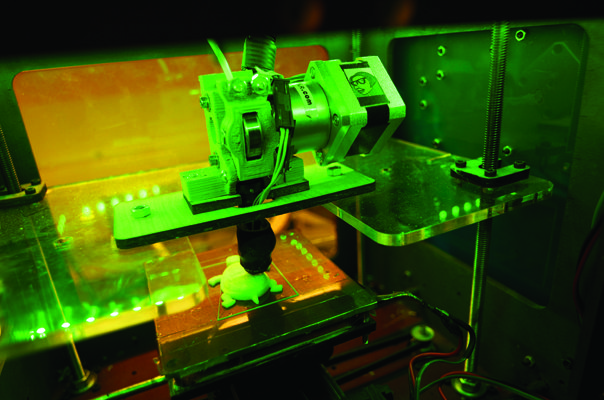
Innovative technology allowing the printing of 3D objects has recently become far more accessible due to companies such as Makerbot introducing 3D printers for home use, with prices starting at around $1,750 (the same price as a Macbook).
The opportunity to use this technology at home has raised worrying questions about product piracy. Products could easily be replicated at home if the general public took the time to create the design file for the printer to read.
Websites such as Defence Distribution, who state their goal as to ‘produce and publish a file for a completely printable gun’, allow anyone with access to a 3D printer to make their own working firearm.
However, it is not just industry set to be affected by this dramatic leap in technology, but the Art World as well. There are many people to be found online claiming to be ‘artists’ who manufacture their art from 3D printers. Can we really call this art?
True, artists have always looked to technology for guidance, from Leonardo Da Vinci’s camera obscurra to David Hockney’s recent exhibition ‘A Bigger Picture’ at the Royal Academy last year, which included pictures created by iPad.
However, it seems unfair to deem printed objects ‘sculpture’ when they are created so effortlessly in comparison to the great labour that must be given to stone carving or clay modeling. ‘Art’ implies that a creative process has been undertaken, and the finished product has been thoughtfully created with great skill. To replace this process with a 3D printer is surely to manufacture, rather than create, and sucks the history and dexterity from the final object.
Furthermore, one of the most interesting concepts of art is the process of translation to the medium used. For example, when Hockney created ‘Winter Timber’ on his iPad, he could have just decided to take a photograph of the landscape before him. Instead, he made a quick painting with an app, exaggerated the colours and warped the perspective in order to create an impressionist piece, so that a spectator is presented with the feeling of the landscape, and not just the cold hard facts of it.
3D printing does not allow this kind of expression and instead presents the purpose of art as merely to replicate; in the ‘Art World’ the 3D printer is a foundry, made emotionless by its lack of tradition and expertise.
Additionally, if (or perhaps when) these printers appear in schools, they may be detrimental to the creative learning of some children. Among young children in particular, there is a desire to replicate real life in art, before they fully understand the idea behind abstraction.
3D printers will fuel this by stopping them from channeling their feelings into the material with their own hands. Although many people do not go on to become artists, it is important to allow every child the chance to find their creative side, and computer-created sculpture may distract from this.
Of course, it is not all black and white. Some people may call a bowl art, where others see it as merely functional. It is possible that if enough creativity is put into the design file, that the printed product can be safely called art. However, this does not mean that it can be classed as sculpture, which requires a more personal touch. The 3D printer is not a craftsman’s tool. To merely manufacture an object is not enough.
Duchamp’s famous ‘Fountain’ shows that even a urinal can be called art if it forces a reanalysis of our perceptions, or makes a bold statement. However it is his presentation of the urinal which makes it art; he does not just recreate it. Perhaps as the technology develops it will be possible to have a more creative approach to developing art via a 3D printer, but for me, it can never capture the charm of a piece of sculpture created from natural materials with a pair of skilled hands.