
Review: ‘Screaming Steel’

By Ruth Townshend
The flood of 888,246 red poppies which recently filled the Tower of London’s moat has been described by Guardian art critic Jonathan Jones as ‘fake, trite and inward-looking – a Ukip-style memorial’. Although harsh, this response highlights the way in which the Hatton Gallery’s exhibition Screaming Steel triumphs where Paul Cummins and Tom Piper’s commemorative installation Blood Swept Lands and Seas of Red fails: in its consideration of those soldiers from both sides of the fence. The Hatton Gallery curators have produced an unbiased exhibition, hanging works by British, French and German artists, whilst also considering a variety of ideological perspectives, art works by pacifists standing in contrast to pro-war propaganda.

The exhibition contains a refreshing mixture of traditional easel painting, sculpture, diaries and manuscripts, with poetry by Wilfred Owen and Siegfried Sassoon printed straight onto the walls. Highlights include an original hand-written manuscript of Owen’s much-quoted poem Anthem for Doomed Youth, complete with scribbled annotations by Sassoon, and Raymond Duchamp-Villon’s Large Horse, on loan from the Tate. Large Horse (1914) appears to oscillate and bristle with energy as you approach and walk around it, the lifelike features of the horse subverted by the cold, hard bronze in which it is cast. Due to its sense of movement the sculpture has been compared to work produced by the Futurists, a group of Italian artists who celebrated the fast-paced nature of modern life. Duchamp-Villon explores the complex relationship between nature and machine: the horse, a traditional symbol of power, appears to morph into a mechanical object. The sculpture appears hunched as if ready to attack, but its sense of liveliness is reduced by being placed in the corner of the gallery- a more central position would have allowed it to make a greater impact.
In the second gallery, Erich Heckel’s 1917 work Man with Hands Held to Head addresses the psychological trauma suffered by thousands of soldiers during- and after- WW1. The pose of Heckel’s figure reminded me of Edvard Munch’s iconic painting The Scream, both works reverberating with paradoxically silent agony. The figure is alone in the picture space, clutching his brow from which furrowed lines extend into the far reaches of the landscape, trajectories which simultaneously hint at explosions, pressures and sounds; ‘foreheads of men have bled where no wounds were’, wrote Owen in 1918. Unlike Munch’s painting, this figure keeps his mouth firmly shut, symbolising the soldiers’ inability to voice their sufferings. Not only the soldiers, but doctors and psychologists were baffled by the thousands of young men suffering from what became known as ‘shell shock’, recognised now as Post Traumatic Stress Disorder. Continuing with the theme of shell shock, Sassoon’s Repression of War Experience is printed on the final gallery wall, as well as Owen’s Mental Cases, a poem which drips with disturbing imagery. Although familiar with Owen’s poetry, I found myself reading it with fresh eyes when exhibited alongside other artistic responses to the devastation of WW1. I found this section of the exhibition difficult. It is supposed to be.
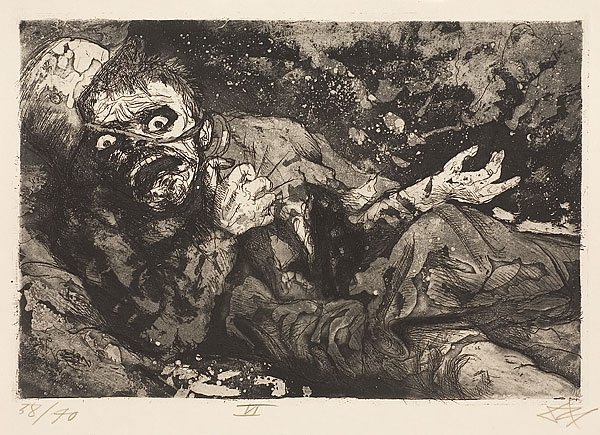
‘In all my dreams, before my helpless sight,/ He plunges at me, guttering choking drowning’: Owen’s lines from Dulce et Decorum Est are placed next to a series of etchings by German artist Otto Dix. Dix’s figure in Wounded Soldier (1916) suffers in a similar manner to Owen’s soldier, ‘white eyes writhing in his face’, blood ‘gargling from the froth-corrupted lungs’. The resemblances between the works are obvious; Owen’s poem could have been written in response to the figure in Dix’s etching, or vice versa. Of course the two men never interacted, but by placing the work of an English poet alongside the etching of a German artist, the curators of the exhibition have forged a vital connection, drawing attention to the universality of the war experience.
Although often considered overly patriotic, Rupert Brooke played a pivotal role in shaping perceptions of the war. Brooke’s handwritten letters and journals in the first gallery are well worth looking at, and I found the handful of olive leaves taken from the tree where he was buried in 1915 especially emotive. The well-preserved leaves were posted to his lover from the island of Skyros, Greece, where he was killed aged only 27. Facing the Brooke exhibit is a selection of pro-war British propaganda posters, which most young visitors surely recognise all too well from GCSE history textbooks (‘Daddy, what did YOU do in the great war?’) The propaganda posters are uncomfortable reminders of the way in which thousands of young men flocked to defend a cause they didn’t truly understand, in defence of a government who promised the war would be ‘over by Christmas’. The posters are attacked later on in the exhibition with an original notebook displaying pages from Sassoon’s Finished with the War: A Soldier’s Declaration on display.
The Tower Bridge poppies were criticised for romanticising the First World War, for creating a scene of dignity, nobility, and worst of all, beauty. In contrast, the artefacts, photographs, paintings and poems which make up Screaming Steel are appropriately disconcerting. If you’re in search of an outward looking, comprehensive review of the artistic responses to the First World War, head to the Hatton Gallery.
‘Screaming Steel: Art, War and Trauma 1914-1918’ continues at the Hatton Gallery until 13th December 2014.
Images: Chris Parfitt, Wikimedia Commons, David Hart