
Kelvin Okafor: accuracy beyond the point of art?
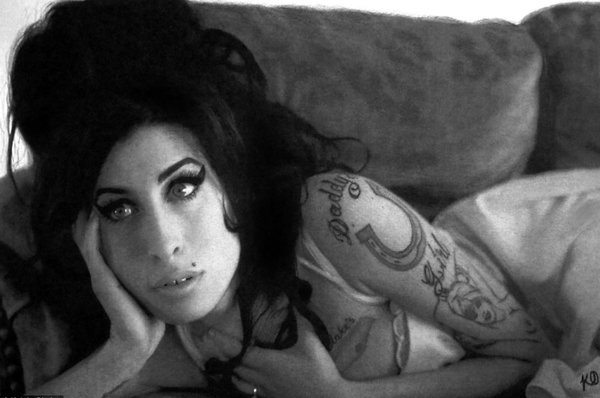
Kelvin Okafor’s hyper-realist drawings can be easily mistaken for black and white photography, however his work has sparked much debate into whether it should be considered art.
The 27-year-old, former Middlesex University art student from London spends up to 100 hours painstakingly drawing from photographs of celebrities from Mother Teresa, to Tinie Tempah and Amy Winehouse. He recently exhibited at the Science Museum and his work sells for up to £10,000. His portrait of King Hussein of Jordan is to be presented to the late monarch’s widow, Queen Noor.
It is evidently a labour of love for Okafor, who had commented “from the pore, from the scars, from the tissues, to the hairs, I feel a very great connection to the subject.” His work has been met with huge support. Art critic Jonathon Jones recently compared Okafor’s work to that of Leonardo da Vinci and lauded his craftsmanship in a culture which overlooks such talent in favour for video, performance and conceptual art.
Okafor’s inhuman level of skill is undeniable however its accuracy verges on unoriginality as they become simply reproductions. As Picasso famously said “It took me four years to paint like Raphael, but a life time to paint like a child.” Okafor’s celebrity drawings tell us no more about the subject than the original compositions do.
His more intimate drawings of family and friends such as his nephew from Nigeria show Okafor’s true talent as he is free to structure the composition and become engaged in a subject which is more personal to him.
Chuck Close, another photo-realist artist, makes paintings of faces which are huge in scale almost covering walls. The experience for the viewer is mesmerizing as you enter into the details of the face as they confront you. Moreover, although Chuck Close’s work is highly accurate, it also conveys boldness in its readiness to experiment with many techniques in trying to portray the human face.
There are currently indications that the art world’s infatuation with conceptual art is declining. The price of Damien Hirst’s work is currently down 30 per cent since peaking in 2008, and one in three of his pieces have failed to sell at all. Meanwhile great works from Picasso and Matisse are increasing in price. Last year David Hockney’s beautiful paintings of Yorkshire were exhibited attracting 700,000 visitors compared to Hirst’s 463,000 at the Tate Modern.
These are all signs that there is a place for Okafor’s craftsmanship in the current climate. However if he fails to experiment with technique, composition and subject he risks becoming a forgotten name in the art world, one who enjoyed his five minutes of fame but was inevitably replaced by others who could draw equally as well.