
Damien Hirst: ‘con art’?
‘I can’t wait to get into a position to make really bad art and get away with it,’ Damien Hirst once commented. He may have made his millions by exploiting our collective greed and stupidity, but Hirst’s first major exhibition in twenty years enticed nearly half a million people through its doors this summer, amassing 6.5 million purely in ticket sales. Recently declared the most visited solo show ever held at the Tate Modern, the exhibition has inspired an unprecedented and inescapable torrent of debate, transforming the world of British art forever.
Hirst explores the truth not through absolutes, but rather through dualities and their ever-present, overwhelming tension. The sterile nature of medicine cabinets and surgical instruments set against the contrasting associations of love, art and religion is a profoundly uncomfortable dichotomy. Organisms lifelessly suspended in glass vitrines of formaldehyde, scientifically capture the serenity of a celestial afterlife. Hatching maggots and flies feeding on a severed cow’s head perform a literal enactment of birth, death and decay. For some, Hirst’s lumps of dead flesh didn’t quite cut it. You’ve seen one, you’ve seen them all. Hirst’s revival of the same motifs has become ‘predictable and unimaginative’.
It isn’t that we tire of Hirst’s mesmerised preoccupation with death, but rather, we avoid confronting the difficult subjects he purposefully explores. His incessant repetition of the same mantra is an inherently uncomfortable reminder of our inevitable end. To look at Hirst’s work, is to stare death in the eye, and for many this experience justifies neither time nor money, and most certainly not artistic appreciation.
Hirst’s questionable yet altogether innovative notions of art have always been accompanied by a vicious public outrage, particularly his reference to 9/11 as ‘kind of like an art-work in its own right’. Unsurprisingly, Hirst has become an artist irrevocably associated with his damaged reputation. This exhibition charts a significant descent in Hirst’s work, a path ironically mirrored by the equally dramatic ascent of his wealth.
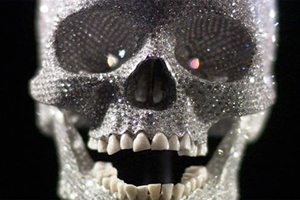
Hirst integrates the vulgarity of material and financial wealth within his art in a shameless showcase of his own excess. Is Damien Hirst critiquing the vulgarity of the art world, or does his work subconsciously reveal the place he has come to occupy in this perverse culture? Perhaps Hirst’s most controversial piece, he saves until last. For The Love of God, a human skull covered in 8,601 diamonds and said to be worth £50 million, is the final showcase of the demise of the world’s wealthiest artist. In functioning like a commercial brand, Hirst is undermining the sentimental value of art altogether. In this exhibition, the only true meaning that remains is financial value.
The question of authenticity arises from Hirst’s controversial Warhol-style artistic philosophy. He has likened himself to an architect running a practice, as opposed to an autonomous artist, only furthering his artistic damnation. For Hirst, however, artistic talent resides in the conception, not the execution. The only difference between work composed by him and one of his assistants, is the money. The fact that he ‘couldn’t be f***ing arsed’ neither lessens the quality of the piece nor undermines his own artistic ability, and that, is conceptual art. Art takes place within the mind. The artist is the inspired fore-bearer of the idea, and it is precisely this transcendence of convention, which has crowned Hirst as a pioneer in the world of British art.
So say what you like about Damien Hirst. This exhibition represents an awakening from our own pre-conceived notions of art, and unless we can overcome and discard these out-dated ideals, the future of art looks bleak.
Photograph: guardian.co.uk