
What’s The Deal With… Minecraft?

by Luke Russell
It’s quite difficult to understand exactly why a Swedish computer game from an independent developer has gained such an incredible following worldwide. Emerging apparently from nowhere, a Swedish programmer named Markus Persson created a game profoundly changed the video game industry.
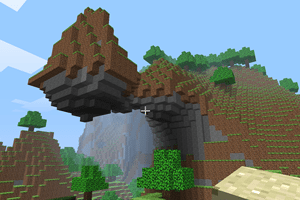
Persson, who is more commonly known by his screen name “Notch”, created Minecraft with his independent video game company Mojang. To someone who has never played it, Minecraft is best described as a sort of digital LEGO. Minecraft generates a digital world that you can explore and manipulate. You can build castles, railway lines, and even electric circuits. Rather than a game, Minecraft should really be described as a massive creation tool. The worlds are filled with animals and monsters just to spice things up a bit, including the now iconic green monsters known as “creepers”, but the game has no story, no narrative structure and no real goals. Despite this, it really is very good.
Initially developed for the PC and Mac and released bit by bit from 2009 to the present, versions of Minecraft are now available for mobile devices and on the Xbox 360. In 2012 Persson won a “Special Outstanding Contribution Award” at the video game BAFTAs as a testament to his impact on the gaming community.
 In a manner that is startling similar to the modern film industry, video gamers are moving away from the more mainstream developers and towards indie developers like Mojang. The fact that Mojang has gone in a few years from being a small scale operation to a hugely recognised organisation is very good for the industry. The success of an unusual game like Minecraft has paved the way for hundreds of other inventive games from indie developers that may never have seen the light of day.
Minecraft appeals to the inner child, the creative streak that maybe you didn’t know you had. Although there is a certain degree of fighting in the game, it is not the focus. Persson himself remarked in a BBC interview that the game is “more about creating and exploring than it is about actual fighting.” The monsters in the game provide an element of danger and motivation, but the game is not really about fighting and killing. This alone marks it out as being distinct from most video games on the market.
At quick glance, Minecraft appears to be a game with strange, simple graphics and no story. In reality the game is much more than that. A quick Google search for ‘Minecraft creations’ shows just what incredible things people are capable of when they have access to a tool such as this.
In summary, the fact that Minecraft has proved such a success shows that gamers are not just interested in playing games where the object is to kill as many terrorists as possible. Minecraft taps into a creative instinct, and it is great that the video game industry worldwide has embraced it.
Minecraft can be downloaded from here.
Photographs: Mojang