
Viewing and working at the Edinburgh Fringe
By Erica Powell
In five weeks I worked roughly 360 hours, for the small fee of £200 – this works out as roughly £1.80 an hour, less than half the minimum wage! So you might ask, what possessed me to sign up for a job like that?
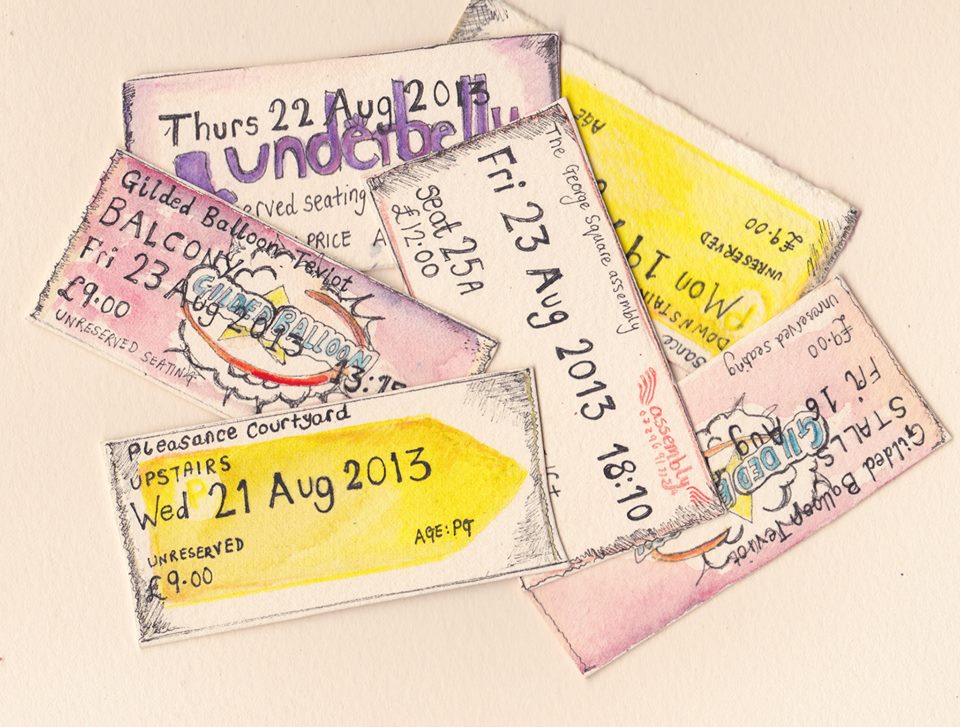
To answer this question I would probably first direct you to the huge collection of tickets cluttering the inside of my bag. Working at C Venues gave me free access to the hundreds of shows and after ushering audiences in and out of performances, I used their reactions to help me form a list of shows I wanted to see.
Any spare time I had I was welcomed (and encouraged) to queue at the box office for free standby tickets. This meant I was able to go see extraordinary and bizarrely described shows without the risk of wasting money.
In fact, before the Fringe I had never thought to listen and watch folk music. This is simply because it’s not the most popular genre and I’ve never been introduced to this style. But the festival gave me the ability to try something different.
After watching two beautifully devised shows, ‘Beulah’ and ‘Transit’, I swear to never be ignorant again. Both sweet, melodic pieces were really enhanced by the soft, subtle folk music – especially the accordion, an instrument I had never considered emotive – which all of a sudden caused me to well up.
Then, there was the folk-rock musical I saw, ‘1000 Suns’, which had a bittersweet but hopeful ending. This musical was performed in Durham prior to the vacation so I was keen to hear the musical numbers once more.
Both versions dealt with the main issue of overcoming oppression in a compelling way but I have to admit that the larger ensemble cast I saw at the Edinburgh Fringe really enhanced the story and gave many of the songs additional power and energy.
This show was quite unique, as Fringe casts are usually relatively small due to the unusual locations that actors perform in. Most spaces at the festival are temporary and not within purpose-built buildings, which means they are often quite oddly shaped and confined. This can be challenging for companies but it was exciting to see how performers adapt and use the stage creatively.
‘The Bunker Trilogy’ carried out an amazing transformation of an empty space in the English department of Edinburgh University by constructing a World War Two bunker from scratch. The audience crammed into the space and sat around the edges of what was essentially a wooden box, whilst the actors performed in the centre.
Unfortunately, not all three parts of the trilogy were executed as well as the reviews suggested. After seeing the brilliant productions of ‘Agamemnon’ and ‘Morgana’, I was heavily disappointed by the last of the trilogy, ‘Macbeth’. I felt that the play made little sense in a war setting and the combination of unconformable wooden benches and a warm, stuffy room, made the final hour fairly painful.
‘Elegies for Angels, Punks and Raging Queens’ also employed creative staging. The Lincoln Company used the seats adjacent to the aisle in the audience as an extension to the stage. This was particularly engaging since the show was a compilation of poems, songs, and monologues reflecting on the lives of people who live with, or have died from, AIDS.
The actors made the experience personal by speaking directly to the audience and asking them questions throughout the performance. It was unbelievable how well the actors’ consistently portrayed their characters throughout the production.
Normally, I would tend to avoid shows that deal with pertinent issues, since they are rarely performed well (RENT being an exception because I love the songs so much). But, strangely enough, I watched several shows about such issues at the festival.
‘Positive’, a newly written, light-hearted comedy, deserves a specific mention as it was named “a must-see” by both ‘So So Gay’ and ‘The Gay UK’. The play explored young people’s perception of HIV in a refreshingly unique way.
Indeed, a visit to the Fringe is a prime opportunity for young people to witness a high standard of theatre and for acting students to reflect on their own performance skills. Three student shows I viewed at C Venues were nominated for National Student Drama Festival Awards: ‘League of St George’, ‘Bin Laden: The One-Man Show’ and ‘Take it Interns.’
All three performances were outstanding and thoroughly deserving of their shortlisting. ‘League of St George’ had an unbelievable energy throughout, even during scene changes which were usually accompanied with band music performed by the cast.
‘Bin Laden: The One-Man Show’ was surprising in several ways. For example, when entering the theatre you were offered tea and biscuits by a white, middle-class student with a flip chart. Overall, the play dealt with controversial issues in an imaginative way – for instance, using flow charts and lists – and was very thought-provoking.
‘Take it Interns’ had a very relevant plot for students and memorable song lyrics, which the front of house/box office team (myself included) were singing for days after.
The Edinburgh Fringe is distinctive in the way that amateurs and professionals perform in the same spaces with ticket prices rarely differing between shows.
While at the festival, I made friends with the two producers of ‘Blues Brothers’ and ‘The Rat Pack’ who, prior to the fringe, had produced a show called ‘Woody Sez’, which was nominated for Best New Musical in the West End and was given five star reviews. This, of course, was a surreal experience and epitomises the uniqueness of the Fringe.
Similarly, it is not uncommon to find famous comedians drinking in Pleasance Courtyard and other bars in Edinburgh during the summer.
Due to the Fringe’s popularity and irrefutable reputation, it has an international appeal and is regarded as the world’s largest arts festival. The Fringe offers a great chance for foreign companies to introduce themselves to the UK audience.
Indeed, this is how I met the Korean cast of ‘Music Show Wedding’, which was a highlight in my Edinburgh experience. The cast greeted me like a long lost friend each time they met me, despite the clear language barrier.
During this show, they were so energetic and every song was performed flawlessly. It’s no wonder I saw the show five times. The performance was so uplifting that I would challenge anyone to watch it and not leave with a grin from ear to ear.
The skills I have developed from the Fringe are invaluable. I have come away with a greater understanding of the technical process and a wider appreciation of different genres and cultures, as well as being informed on a number of topical issues.
The Fringe is also a great place to network if you have any interest in a theatre-related career, and the people you live and work with will remain close friends. So, if you’re keen on theatre and aren’t afraid of hard work and long hours, then the Edinburgh Fringe is an extraordinary opportunity.
If you choose to apply to work there next year, I wish you luck! If not, then I definitely recommend a visit, there’s nothing else like it.
Illustration: Harriet-Jade Harrow