
Review: ‘They Used To Call It The Moon’

By Kimberly Ong
The Moon is Earth’s only natural satellite, a quarter of its size, moving around our home planet in cold and lifeless isolation, in an orbit that increases an inch and a half a year. Yet, this lifeless sphere of rock and dust has pervaded human consciousness and popular culture today, adopting many protean identities throughout time.
In archetypal culture, the moon has various associations with mystery and the supernatural, such as the belief in ‘moon madness’. In science, human fascination with the moon led to many advances in space exploration and technology. With China launching its Space Rabbit this December, and moon landing conspiracy theories still rampant, the moon is still very much a topic of contention.

When we talk about the moon, we are in fact talking about the Earth, and the imaginations we imbue upon it. The group exhibition They Used To Call It The Moon at BALTIC Centre for Contemporary Art presents the moon as a canvas, with various contemporary artists from Pakistan, France, Germany, Croatia, the US and UK inscribing reactions towards the phenomenon and discovery of the then unknown planet. It dabbles with film, photography, drawing, sculpture and collage.
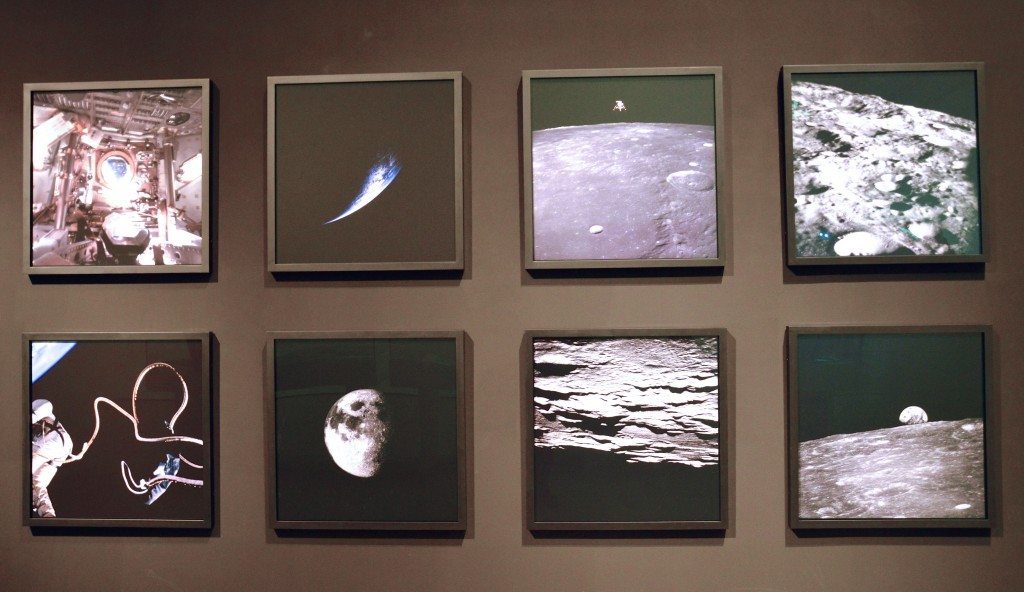
The interspersing of science and fact in art is a key component in the exhibition. Large images of moon and space fill the exhibition walls, courtesy of artist Michael Light’s project FULL MOON, with photographs taken from NASA’s archive. Yet another focal point is a huge silver sphere from Trevor Paglen’s sculpture over seven metres high, designed as prototype with aerospace engineers to be placed into low-earth orbit and reflect sunlight from space to the earth’s surface.

Integration of space technology in Katie Paterson’s Earth-Moon-Earth features a self-playing piano of Beethoven’s Moonlight Sonata. She uses the technology of moon bounce to translate the musical score into morse code, sending it to the moon and back. Its returns were fragmented, with the surface of the moon having absorbed some of the code. This combination of technology and enigma is a representation of the moon and our relationship with it; we project our signals and desires out to it, but what we get back from it are fragments.
Past astronomical discoveries are reflected in both Aura Satz’s and Simon Starling’s works. Her Luminous Distance is a development of Satz’s research into the little known pioneering female deaf astronomer, Henrietta Swan Leavitt (1868-1921). Using a double slide projection with a blink comparator that allows rapid switching between images of the moon and female scientists, it opens up a little publicised side to the history of astronomy.
Moon discovery has also sparked imaginations of alternate realities. Marko Tardic’s We Used to Call It: Moon. It consists of collages of found vintage postcards, considering a fictional reality with the discovery of a second moon. It invites us to consider various narratives that come out of space discovery and how this may seep into our collective imaginations. Joseph Popper’s The One Way Ticket is a multimedia installation of a makeshift space capsule, a mission trajectory map, and a video, all which proposes to send one person on a voyage into deep space with no return.
Conspiracy surrounding the moon is never far away, and touched upon in Kate Liston’s three screen video installation Moon Rabbit, combining the Chinese myth of Chang’E with American icons such as the playboy bunny. The legend is featured in modern space lore as the Apollo 11 astronauts were told of a newspaper headline asking them to look out for rabbits when they made the first Moon landing. Cultures through myths are shaped by their makings of the moon.
The exhibition also presents material from Stanley Kubrick’s visionary film 2001: A Space Odyssey, with the late director’s vision of the lunar landscape and dialogue with sci-fi writer Arthur C Clarke who inspired the film.

The blending of technology and imagination, fact and fiction is a key component within this exhibition. Packed with lunar maps and photograph, mythology, conspiracy theories and utopian and dystopian visions, these artistic responses allow us to immerse into the wonder of mystery surrounding the moon today. Most importantly, it reflects our shared experiences and responses with the moon.
‘They Used To Call It The Moon’ runs at the BALTIC Centre for Contemporary Art until the 11th January 2015.
Photographs: Kimberley Ong