
Review: Durham Drama Festival: Ozymandias
Ozymandias tells the story of Ramesses the Great, the King of Kings, lamenting on his past and lack of relevance in modern day society. Throughout this thirty-five minute production Ozymandias, ably performed by Hugh Train, entertains the audience with speeches on the human condition, targeted confrontational exchanges with unsuspecting individuals and even a heavy-handed guitar recital thrown in.
It was clear that a good deal of thought had been put into the production. The Norman Chapel provided an intimate pillared performance space, and worked well.
The stage was enclosed by a single row of uncomfortable wooden benches, forcing the audience no option but to take front row seats. This sense of entrapment and intimacy was accentuated by the lighting state. With light focused almost exclusively on the stage, the surrounding areas of the chapel were dark and eerie, offering no relief for audience members wanting to distance themselves from Ozymandias’s close proximity. I particularly liked the occasional noise of the stone floor of the Chapel grinding beneath Hugh Train’s bare feet; it worked well when discussing the lack of moisture Ozymandias faced when spending so many years in the desert.
Train’s costume consisted of nothing but a simple piece of cloth wrapped around his waist. This complemented the piece well, and would have worked perfectly had it not been for the fact that the cloth unfortunately drifted gradually lower, revealing Hugh’s modern underwear. It certainly did not lessen the quality of the performance and it was perhaps inevitable, but it was noticeable to the eye.
Train’s performance of Ozymandias was of good quality – as expected from an actor who had written the script he was performing. His constant exchanges with the audience created a sense that we were as much a part of the performance and we were spectators. More impressive was the feeling that Train’s responses were not merely pre-set prescriptive small-talk designed to engage us, but a confident display of often highly comical ad-lib reactions to audience expressions and replies.
Train appeared to relish in his proximity to his audience, taking many opportunities to confront members directly, with at one memorable occasion, leaning in close to a lady’s face and muttering ‘kiss me’. I cannot claim to say I had such an exposing experience, but there were occasions where Train’s bare torso was merely inches from my face.
There were areas of Ozymandias where I was unconvinced. Train’s frozen body standing with his back to the audience upon our arrival appeared to have little significance in the grand scheme of the play. The painfully slow and heightened manner in which he first poured the milk also seemed to have no real meaning, and, if I am honest, was a bit pretentious. Perhaps this was Train’s intention.
Whilst I did enjoy the comedic value of the audience involvement, I also felt that the play would not have suffered if one or two of the more drawn-out exchanges were removed.
Despite this, as the performance continued I became more convinced and enticed by Ozymandias, and I particularly liked the way Train was able to reveal a more vulnerable side to the character when discussing his glorious past. I only wish I read the poem presented at the start of the performance a couple more times before watching the performance, as it would have added greater context to the piece.
Overall Ozymandias was a very good production For a play that could have easily descending into a one-man show of pretentiousness and over-egged dialogue, Hugh Train and Penny Babakhani have done well to produce an enjoyable and engaging piece of theatre.
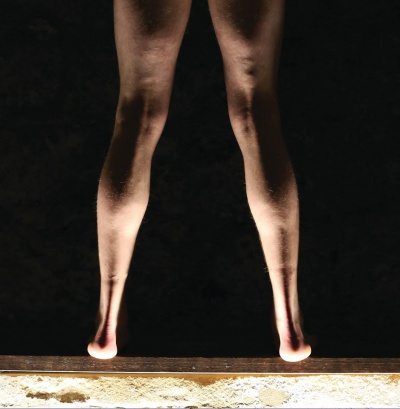
Image: Hugh Train