
Review: Bread Alone, a collection of creativity by working-class writers
By Stella Fenwick
Bread Alone is a collection of essays spanning a variety of career paths, life-stages, backgrounds and countries, demonstrating the diversity of working-class writing. It was edited by Prudhoe creative Kate Pasola, and published by Indie Novella. It collects the stories of 33 writers in snappy and emotive essays, united in exploring the question on the front cover: “what happens when we run out of working-class writers?” It is a beautiful addition to the fight for recognition of working-class hardships and bravery within creative sectors in an age where grants and awards are on the decline, and performative inclusivity in creative sectors has proven brutally defective.
Each essay was tight and clever, and I loved the range of voices, a reminder that the working-class label is capable of containing a plurality of identities, rejecting the limiting stereotypes often associated with such collections. A surprisingly expansive range of topics were explored, including accents, beauty standards, sellotape and the all too familiar question: “what was the profession of the main earner in your household at age 14?” Stand-out essays had unique creative styles, sometimes melting into free-form poetry or humorous re-workings of typical, privileged writing-guides. They pushed the boundaries of what the reader expects working-class writing to look like, but this stand-out level of creativity was surprisingly lacking across the collection.
It was a real reminder that working-class creativity is under-funded, under-supported and direly difficult for anyone to survive pursuing
I devoured the first half in one sitting, highlighting lines, scribbling praise in the margins, even opening my laptop to look at Creative Writing Masters, something I always dreamed of but wrote-off for all the usual reasons working-class people deny themselves into these creative, financially-demanding places. But soon came the feeling that almost every essay was a repeated rehash of the last, and I started getting tired of this dull repetition.
I understand why it happened: working-class writers were told to write about why working-class writing is important, and to help convey this, they each reached to their own personal history. This life writing was undeniably interesting, but its rapid repetition was tiring. Similar statements were repeated across the collection without new meaning or movement given to them, which was frustrating. The autobiographical essay was not what I was expecting when I was drawn in by the collection’s subtitle: ‘what happens when we run out of working-class writers?’, and I was left hoping for a more future-facing, global, expansive reflection on working-class creativity beyond the bounds of personal experience. It soon became clear that an anthology of life-writing cannot imagine and discuss a future, it can only repeat the past, making it feel like writers of the future will always be stuck in a rut, stuck re-describing the cold of the glass ceiling without seeing and creating a world beyond it.
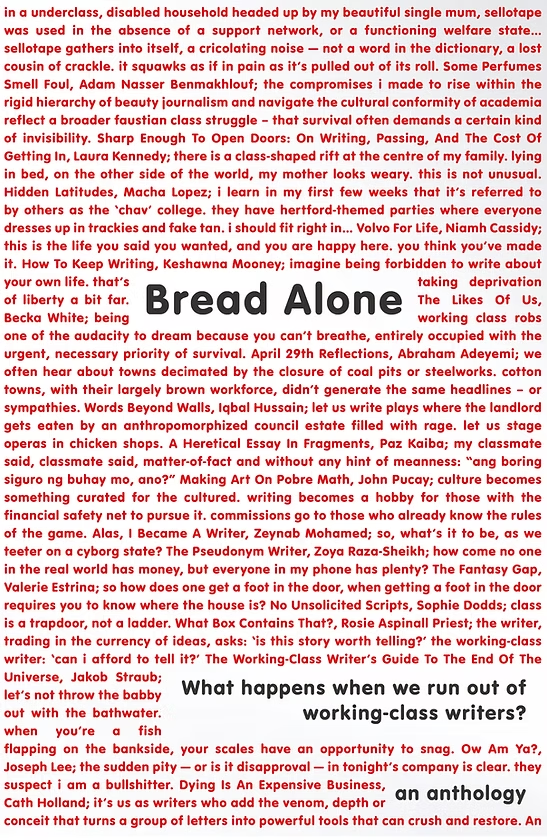
Still, I do not believe that books like this should give in to false optimism. The collection of autobiographical stories were a real reminder that working-class creativity is underfunded, undersupported and direly difficult for anyone to survive pursuing. But for a book imploring its reader to remember that the world needs working-class artists on film sets, in writers rooms, on gallery walls and behind news desks, the book was not very hopeful or encouraging to aspiring creatives. The continual plea to the reader to keep writing fell flat when there was no clear encouragement on why one should continue pursuing such a difficult and dwindling path. I felt that I was not shown what the world would be lacking when it runs out of working-class creatives, only that it will soon happen. This gave a hopeless tone to the collection. As an aspiring, working-class writer, I didn’t feel convinced by the plea to keep writing.
Eventually, I again closed all of the tabs I had created for Creative Writing MAs. The ache in my chest when I continued reading the collection lingered with me through my days, generally making it difficult to continue pursuing the creative life I had imagined for myself. I held off sending the book to my Durham-based writing group for the same reason. Bar a few, each essay seemed to end with a gloomy look at our path — each writer lamented not being rewarded for their time and creativity, shouldering the guilt that they had left their parents or background behind, each worrying that they would have to give up writing soon.
Only a few essays took another course, one I felt better embraced the subtitle of the book. It was inspiring to read about where a writer saw the working-class creative style developing — how it should be unique, anti-publisher, fragmentary, sweary, rejecting linearity. I also loved the constant questioning about how much we should sell-off our pasts, our “grit”, to make “poverty porn” which wins over publishers, award judges and Waterstones customers, but, unfortunately, such questioning came a little flat when it felt like the collection of Bread Alone was largely doing exactly this. I felt like the creative possibilities of our unique experiences were not pursued, it simply remained stuck in our pasts.
Rather than stewing in our own pasts, I wish that these creatives tried to imagine a future where working-class writers are necessary and are free, to give the reader a glimmer of hope
It is true that, as working-class creatives, our backgrounds, financial situations, and experiences with accent or imposter syndrome are constantly in our minds, pursuing us into every new room we enter, however glamorous that room is. So I wonder if replicating this feeling across the collection through the repetition of the life-story essay, and the constant rejection of hope for future creatives, was purposeful to immerse readers in the sensations of life as a working-class creative. But despite repeatedly imploring the reader to remember that working-class creatives do not always want to write about being working-class and the stereotypes which publishers associate with this, it felt like the collection was struggling to break out of exactly that. It is true that allowing working-class writers to write about their class on their own terms in collections such as this is important for allowing us to re-define and reclaim what our class means beyond the stereotypes, but I would have liked to see more creative imagination beyond the boundaries of our pasts, beyond the life-story essay on repeat. More creativity doesn’t ignore the fact of the obstacles it has taken for us to make our voices heard, it proves that working-class writers are capable of more than just their label, and that’s a vision I felt lacking in the collection. I did not feel empowered or reminded of the multitudes we are capable of, I felt like a parent was telling me all the ways that my dreams are bound to fail, all the ways the path I wanted to pursue was never carved out for someone like me. There is truth in this fact, but I wonder if absorbing and replicating it into our own essay collections, allowing these obstacles to limit our creativity even here, is simply giving in to the wishes of the elites and the structures which push us out.
In a stand-out essay, Paz Kaiba writes that “the most radical act a working-class writer can perform is to imagine a world in which their class no longer suffers. […] To write not only the truth of poverty but the fantasy of its end. […] To fabricate freedom.” And this is something I wish the collection did more. Rather than stewing in our own pasts, I wish that these creatives tried to imagine a future where working-class writers are necessary and are free, to give the reader a glimmer of hope, however radical and seemingly unrealistic, just a hint that we, as creatives, can create a narrative future writers feel empowered to contribute to.
Nevertheless, Bread Alone is a necessary and wonderful project, and a useful list of creatives to keep on your radar. The range of voices it assembles is diverse, and its best essays remind us not only that working-class writers exist, but also the developing creative styles that would not be possible in a world where the barriers continue piling up. However, the collection was repetitive and limited by the life-writing habit, as if too scared to imagine a world where our creativity can tell the story of more than just our pasts.
Bread Alone will be released on Monday 9th March 2026, and can be bought at this link: https://www.indienovella.co.uk/product-page/bread-alone-what-happens-when-we-run-out-of-working-class-writers
Image: Bread Alone via Indie Novella.


