
Looking back on a festival-filled summer
Briony Chappell
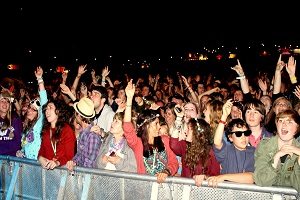
Maybe its the subliminal message behind the name ‘Bestival‘ (Best Festival, Best-of-all etc.) or perhaps the excuse to dress up to the nines in fancy dress, but there is something magical about this festival that manages to drag half of the student population to the Isle of Wight in early September for four days of music and mud-fueled madness.
Now in its eighth year, Bestival has grown in popularity and size at an unbelievable pace, one that still appears to gobsmack even its proud father, DJ and producer, Rob da Bank. Last year it was voted ‘Best Major UK Festival‘ in the UK festival awards and it’s easy to see why.
With one of the biggest line-ups of any UK festival this year, the event hosted artists of almost every genre over 12 very different stages. The main stage saw three major headliners: Pendulum, Bjork, and The Cure.
Bestival were particularly proud of securing the latter, and there are not many words that would do a headlining performance by Robert Smiths’ infamous rock band justice. Since the 1970s, The Cure have surfed their way through various waves of rock genres, including punk, gothic and post-punk. Some of their greatest hits from “Friday, I’m in Love” and “Lovesong,” to “Boys Don’t Cry” remain anthemic sing-alongs for even the youngest of the festival’s student army.
The weekend also saw sets from Katy B, Paloma Faith, Kelis, Noah and the Whale, and the 2011 Mercury Music Prize winner, PJ Harvey.
The biggest success story of the weekend arguably came from The Maccabees. Their first Bestival performance in 2007 showcased a small indie band promoting their debut album, ‘Colour It In’. This year they returned to the main stage on Sunday afternoon with a bold set that didn’t revisit much of their original album. The band played a substantial amount of new material suggestive of a heavier, more electronic direction.
Bestival however, extends far beyond the realms of music. Using the picturesque setting of Robin Hill Park to grab even the shortest of attention spans, extra activities included the ‘Ambient Forest’, ‘Bollywood,’ a vintage Roller Disco, a burlesque tearoom, an inflatable church, and much, much more. As always, a fantastic weekend, and a strong contender for festival of the year.
 End of the Road: a gem worth finding.
Will Clement
Hidden in the wilderness of the Dorset/Wiltshire borderlands, End of the Road is a fitting finale to the festival season. Founded in 2005, this is a festival free from over-hyped headliners, where bands play longer, more intimate sets, and where the food, drink, and decor plays as great a part as the music in creating a unique experience.
Dry the River was one of the first bands on the Woods Stage on Friday, full of the catchy semi-acoustic hooks that have been earning the band plaudits across the board. After a build up of dry ice and strobe lighting, Swedish singer-songwriter Lykke Li burst onto the stage clad all in black, and launched into a mesmerising set. Headliners Beirut rose admirably to the unenviable challenge of following her, their Eastern-European influenced songs softened by tender vocals and lyrics.
Saturday offered yet more musical diversity, from the crazed Bob Log III, who played his entire set in a blue jumpsuit and modified bike helmet, to exciting electronic band Austra. The headliners, Glaswegian post-rockers Mogwai, closed the Woods Stage with a blistering set.
Sunday saw North Carolinian Megafaun bring the sun to the Garden Stage. For the upbeat ‘Second Friend’, drummer Joe Westerlund led the stripped-down rendition on guitar as the others sang backing vocals, smiles breaking out on every face, both on stage and in the audience.
Meanwhile, North-African group Tinawiren transported the crowd to the Sahara, and End of the Road veterans Midlake gave an unforgettable performance, even previewing some scintillating new songs.
Closing the festival was the delicate yet gripping harpist and vocalist Joanna Newsom. Her late-billing meant that her set could drop to tender lows without the overpowering blare from another stage, and the dainty songstress was still on stage close to midnight for a rapturously received encore.
Defending the increase in ticket numbers and the new, larger stage, organiser Simon Taffe had stated that ‘whilst bigger is not always necessarily better, it is not necessarily bad’. End of the Road 2011 emphatically reinforced this statement, with a lovingly assembled lineup and plenty of arty quirks combining wonderfully.
 Green Man: more than a little change of scene.
Briony Chappell, Jess Denham.
Growing up in the Reading generation has unconciously shaped our festival experiences and taught us to expect certain scenes that stand in stark contrast with the civilized nature of Green Man.
Set in the picturesque Brecon Beacons, it is one of the most popular festivals for fans of peace, love and first class music.
Headlinging this year were Explosions in the Sky, Fleet Foxes and Iron & Wine, all of whom gave spine-tinglingly beautifully performances set against the backdrop of the Welsh mountains. Notable highlights came in the form of Matthew and the Atlas, Noah and the Whale, and Dry the River, the latter having played at Durham’s very own Vane Tempest Sessions last November.
Laura Marling bewitched the main stage crowd with songs from her latest album, whilst Bellowhead inspired a mass hoedown with their irresistable concoction of 25 different instruments.
The chilled-out atmosphere, abundant musical talent and understated hedonism of Green man formed the perfect antidote to dirty campsites and midday brawls.
 Reading: the heartland of rock.
Julie Fisher
Despite living less than ten miles from the festival site, up until this summer I had never been to Reading Festival. This year I decided to rectify this but, fearing that this decision might be in danger of making me cool, I only went on the Sunday, and was accompanied by my father. Yes, I am old enough not to need a chaperone, but as he’d paid for my ticket, I could hardly refuse his company.
Although I spent most of the day telling my father in no uncertain terms that he is not a rock god, I thoroughly enjoyed my first festival experience. Muse, who played the ‘Origin of Symmetry’ in full complete with fireworks, plumes of smoke, and a larger than life recreation of the album cover to bring the festival to an end, were the highlight for many. But for me, nothing could beat Frank Turner.
I was already a fan of Frank Turner’s music before Reading, but by the end of the day I was obsessed. Having played every stage at Reading at least once, he fully deserved his spot on the main stage this year. His songs are, in my opinion, perfect festival music: easy to sing along to, with strong beats and lyrics which really make you think. And if that wasn’t enough, it was obvious that he was genuinely enjoying himself (he told the crowd so enough times) and his enthusiasm was infectious. Most bands had people clapping along; Frank got the entire crowd to sit on the ground. From that moment he could do no wrong. In fact, the first thing I did on arriving home was book tickets for his tour in November.
So thank you Reading, I will be coming again, but maybe next time without my father in tow.