
In awe of Turner

By Beth Woodley
During a week’s work experience in Newcastle, I decided to spend my lunch break at the Laing art gallery in the city centre, visiting the Turner and Constable exhibition. The exhibition assembles a large body of over 60 Turner and Constable original works from the Tate Gallery collection.
‘Turner and Constable: Sketching from Nature’ exhibits works set and painted outdoors and celebrates a new approach to landscape painting that was gaining popularity at the turn of the Eighteenth Century. JMW Turner was one of the first painters to take his easel outside and in doing so pioneered a new technique to create art. Turner owned a boat that he would take out and moor in the middle of rivers, often the Thames, in order to achieve a heightened naturalism in his works. This approach gave Turner the opportunity to have more freedom and movement in his painting, rather than being held back by the constraints of the studio.
One such piece depicting a peaceful rural scene is Turner’s Harvest Dinner, Kingston Bank (1809) in which a group picnic on the bank of the river. There is a highly naturalistic feel with the man in the foreground who leans down to wash his face in the river, Turner capturing his blurry reflection in the river beautifully. Turner also brings perspective into play with the bargeman in the background of the painting.
My favourite Turner in the exhibition, however, is The Thames near Walton Bridges (1805). This painting is stunning in that it demonstrates how ahead of his time Turner really was. This depiction of a house on the river bank, with boats moored and the bridge in the background has a very impressionistic feel to it, despite being painted decades before the Impressionist movement. The quick, visible brush strokes suggest a work that was executed quickly outside in a natural setting. Nevertheless, Turner manages to capture the rural beauty of the scene. The light and shadow effects and tinting in the clouds create an atmospheric mood.
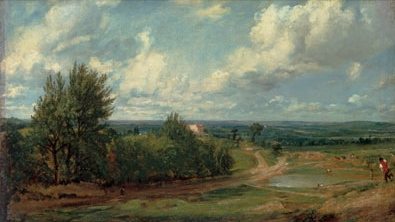
This new approach in painting was highly daring and new at the beginning of the Nineteenth Century. According to John Constable, Turner’s contemporary and rival, ‘by a close observation of nature, [the artist] discovers qualities existing in her which have never been portrayed before.’ Indeed, in Constable’s Hampstead Heath with the house called the Salt Box’ (1819) the viewer gets a real sense of open space as the heath rolls out from the centre of the painting for as far as the eye can see. Over half of the painting is taken up with Constable’s detailed depiction of cumulus clouds.
What struck me whilst walking round the exhibition was the distinct British quality of the paintings. Both Turner and Constable depict highly British, rural scenes of villagers, children and harvests. However, there is also implicitly a sense of the strength of the British Empire with numerous paintings including trading boats and barge ways highlighting the importance of waterways in developing Britain’s prosperity.
The exhibition features a number of paintings by other, less well known artists including John Crome and James Johnson. I particularly liked James Ward’s sketch for Gordale Scar (1811). Following in the footsteps of Turner, Ward takes his easel outside and manages to accurately portray the rugged nature of the landscape of the Yorkshire Dales. There is a real sense of the power of nature as the river comes gushing out of the craggy hillside.
My only criticism was that, as with all too many exhibitions, there were no female artists represented. For example, the exhibition could have included Mary Ellen Best’s scenes of village life from her sketchbooks or the influential work of Susanna Drury in late Eighteenth Century Irish landscape painting. Nevertheless, I thoroughly enjoyed the exhibition and its depiction of landscape painting.
Images: Wikimedia and Tate