
Cheks, Drugs and Rock ‘n’ Roll
By Victoria Ferguson

It was for this reason that I watched the people across from me with scepticism. A group of young American teenagers, no doubt on a school trip, slumped themselves into their seats, chatting and giggling in that ‘I’d better appear too cool for this’ kind of way.
I found myself hoping to God that this adaptation wasn’t going to be too alienating because, despite my eagerness to experience some of The Young Vic’s characteristic edginess, I didn’t want these visitors to the cultural heart of the UK to go home with more enthusiasm about the tacky Union Jack hoodies that they had bought from a Piccadilly street vendor than about Benedict Andrews’ most recent triumph… And I wasn’t too keen on suffering the consequences of a group of bored and irritable school kids for 3 hours.
From the moment the three sisters step out onto the stage however, the audience can see that there is no question of this being a pretentious or elitist adaptation.
Throughout Olga’s opening speech, Masha sits with her legs dangling off of the edge of the stage, smoking a cigarette in a way that says to the audience, ‘it’s okay if you’re not getting the symbolism of the snow and the clock striking eleven. I don’t give a s**t either.’
 Irina looks between her sisters with the innocent curiosity of a youngest sibling and all three master the subtle conflict between the vibrancy of their youth and the exhaustion caused by a life of vain dreaming and fruitless longing. These characters are believable, relatable. None of the standing-centre-stage-and-finding-the-light-for-your-monologue staging that can become quite typical of the classics.
With the sisters skipping excitedly around the stage when they aren’t sprawled unapologetically on the floor, the audience is invited into this family’s intimate circle, encouraged to get to know them and to laugh and cry unashamedly with them. So perhaps the American students, slouched in attitudes of pure unpretentiousness opposite me, had the right idea after all.
Chekhov’s play is catapulted into the 21st Century with the use of iPhones and references to televisions and modern day rock classics. Initially this is a little jarring for an audience who is not expecting such a shamelessly modernised reinvention of the classic, but I was ultimately won over by the grimy honesty of the production: the drinking, the swearing, the crude sex jokes and the unusual decision to have the cast belt out a drunken tribute to Nirvana’s Smells Like Teen Spirit. All of these factors serve to make the play accessible and what theatre should essentially be – good entertainment.
The beer-bellied Andrey, the ridiculous carnival costumes and the absurdity of the doctor frolicking around in a pink frilly dress did inspire a little too much hilarity amongst the audience at times, to the point where the uncontrollable laughter of the people around me prevented me from feeling too despairingly for Chebutykin in what should have been a tragic moment of existential crisis. However, I think that this was more due to the excitability of the young audience that evening than to a ridiculing of Chekhov’s message by Andrews. In fact, for such a brave and alternative adaptation of the play, Chekhov’s message has remained remarkably intact.
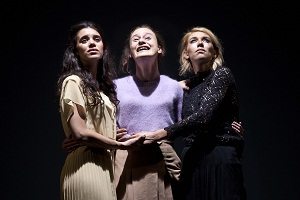 Throughout the play, the Prozorov sisters’ despair is almost tangible. The stage is dismantled throughout the scene of the town fire and so, by the end of the production, both the stupid futility and the admirable strength of their continued persistence in the face of everything is reinforced by the emptiness of the performance space.
As they clamber up that heap of soil together at the end of the final Act, the striking reality of the instability of their foundations and the vulnerability of their happiness reaches its moving climax.
Benedict Andrews may have unwittingly created thirty new Chekhov devotees on the evening that I saw his fresh and exciting reinvention of the classic. Yes, they may have all been sporting Justin Bieber haircuts and neon sneakers, but so what? Andrews has reminded us with courage and flair that Chekhov is for all people and for all time.
Photographs: Simon Annand