
Charity Work in Peru
The words “work” and “study” are synonymous with student life, and the word “fun” isn’t always associated with them as one slaves away in the library desperately trying to cut an essay down to below the word limit (or, for some people, typing something up to hand in by the end of the day…)
But during the year abroad of a linguist’s degree, “fun” certainly can be the adjective of choice.
Yes, a 1,000-word essay has to be submitted for each fourth-year language module a student intends to study. And a work or study placement is by no means an easy ride for third years as they constantly operate in a different language and culture.
But, as I discovered this summer, language improvement can happen just as much – if not more – doing none of the above.
Having taken up Spanish in my second year at Durham I was under no obligation to go to a Spanish-speaking country before my final year. But a Christian mission trip to Peru for seven weeks this summer not only dramatically improved my Spanish but was a truly unforgettable experience.
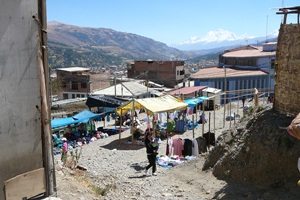
 Our team of ten Britons (sent by the organisation Latin Link) were based in Huaraz, an Andean city within sight of many of Peru’s highest peaks. There were two others on my team who spoke Spanish, but that hardly limited the opportunities for practising the language. For, apart from us and several other overseas volunteers or long-term missionaries, there were no English speakers in the region.
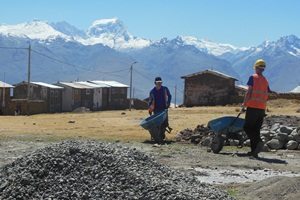
We spent a few mornings each week doing a building project, my language improved trying to understand what jobs needed doing, where bricks needed stacking or simply explaining to the workers why we “gringos” kept on turning up to help build a new school!
When helping at an orphanage full of excited children wanting to communicate with you, there was never a lack of opportunities to speak with them in Spanish. This was also the case when getting to know the locals, friendly chats with them, or finding out about their traditions and customs.
Unfortunately many people in the mountain village (4,000 metres above sea level) where we stayed for part of each week were monolingual in Quechua, the native language and thus rendering communication impossible. But life there helped us to appreciate their local culture, ranging from trying their local dishes, helping them with tasks or community activities or simply experiencing a way of life so different from our own.
Opportunities specific to a Christian mission trip enabled me to put my language learning into action. From sharing my faith to inviting people (and their farm animals…) to church and teaching the Bible to rural children, there were plenty of fabulous experiences which simultaneously improved my Spanish.
 Interpreting church sermons for team mates or being a price negotiator at the market ironically meant that being with other Anglophones often led to more opportunities to use the language.
Apart from the inevitable tourism at the end of our trip, I must say that one of my highlights was helping a teenager with their maths homework in the rural Andean village. Not only did it “justify” the hours spent on trigonometry and mechanics 1 at A-level, but explaining it in a language (of which I had no knowledge one year previously) exposed to me the joy and practicality of using languages, which goes far beyond learning verb tables…
So if volunteering is your passion, then I’d thoroughly recommend doing it on a year abroad. There are many organisations which work in Latin America (for Spanish students) or some African countries (for French students). You won’t get an Erasmus grant, and hot showers, central heating, a self-flushing toilet and UK brands certainly aren’t guaranteed.
But as a place where you’ll get language immersion and unforgettable memories as well as experiencing a totally different culture to one’s own, there are few better options.