
A picture paints a thousand words
In fact, Exeter University even includes Alison Bechdel’s autobiographical comic Fun Home on its first year “The Novel” module for English students. Meanwhile, here at Durham, Joe Sacco’s Palestine, a pioneering fusion of journalism and comics, is offered for study on the English Department’s “Literature and Terrorism” module. TIME Magazine even showed their support for the genre by canonising Alan Moore and Dave Gibbons’ Watchmen in their list of the 100 greatest novels. So just when did it become acceptable to bestow “literary” attributes onto a comic book?
In Japan, it seems that comics (referred to as “manga”) have been a part of mainstream culture for a lot longer that they have in the West. In fact, the entire world of comics owes a great deal to Japan’s “God of Manga”, Osamu Tezuka. Beginning his career in the 1940s, Tezuka practically invented the “vocabulary” of the modern comic book. He was one of the first artists to incorporate cinematic style into his drawing, and his combination of hyper-real environments and cartoony characters has been emulated by innumerable successors. However, it is not just in style that Tezuka was a pioneer. His works often address complex themes, such as sexuality and the ethics of chemical warfare in MW, and spiritual enlightenment in Buddha.
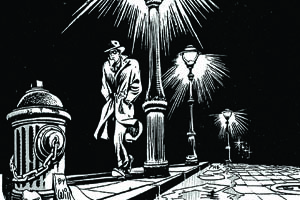
In America, working at roughly the same time as Tezuka, was another legend of the medium: Will Eisner. His long-running series, The Spirit, experimented with the incorporation of narrative text and dialogue into an image, alongside unconventional panel layouts, in an attempt to break down the boundaries that had been built around comics. Indeed, nearly forty years later, Eisner heralded in a new era when he published A Contract With God in 1978. As one of the first American comics to be published in book form without previously having been serialised, A Contract With God opened doors for a new generation of artists.
However, the comic did not fully take off as a literary form until the 1980s, when Art Spiegelman began serialising Maus, a true account of his father’s life during World War II and his ordeals in the concentration camps. Maus was the first comic to be embraced by the literary community: it was a New York Times Best Seller and in 1992 was awarded the Pulitzer Prize. Spigelman’s metafictional narrative structure, his self-destructive use of metaphor (Jews are portrayed as mice; Germans as cats) and his subtle visual motifs all served to prove that the comic form is as important a genre as any other. And now, over thirty years after it first began serialisation in Raw magazine, Maus is still regarded by many as the most important work in the medium.
It is largely thanks to innovators like Tezuka, Eisner and Spiegelman, that the comic book sector is now the fastest growing in the publishing world. While it may be true that the old “funny pages and superheroes” stereotype still surrounds the word “comic”, the industry is both gaining in popularity and certainly not short of new great minds. Comics are still somewhat on the fringe of literary acceptance – but that fringe is encroaching, slowly.
Illustration: Will Eisner