
“Not even water?!”: Experiencing Ramadan on my Year Abroad
I knew that I’d be in Oman during the first two weeks of the holy month of Ramadan when I booked my plane tickets months before I even arrived. Of course I’d already learnt about the basics of this important part of the Islamic calendar year from my first and second year Arabic classes, but that’s only what I knew: the basics. Experiencing Ramadan first hand is both frustrating and magical, but mostly it is a time of learning – learning about the heart and soul of a culture and its people.
Oman is an undiscovered gem; an up-and-coming destination for Arabic students, abounding in rich architecture, stunning natural scenery and, yet, it’s not too touristy. It’s an absolute monarchy with a beloved Sultan who has ruled for over 40 years and pulled the country out of the Middle Ages. Islam is the official religion, and the basis for laws, traditions, and customs. The Sultanate, which is situated on the Persian Gulf, is therefore conservative, and this conservatism is heightened during the month of Ramadan. Eating and drinking in public during daylight hours at this time of the year is punishable by law and can end you up in jail with a fine. There are no restaurants or cafes open until after sunset, which makes falafel and karak (a delicious, milky, spiced tea) cravings unquenchable. But I tried and look past the inconveniences and focus on sharing in the traditions, which didn’t mean fasting necessarily, but still feeling a part of it all. After all, that is what the Year Abroad is about.
The month began with the sighting of the hilal, ‘crescent moon’, that indicates the beginning and end of the holy month. Some countries go by Saudi Arabia’s announcement of the hilal, but Oman chooses to declare the beginning of Ramadan with a local sighting, overseen by an official committee. I leant out of the window ledge on June 17, a Wednesday, and listened to the prayers coming from the local mosques, the heat creeping into the room despite the time of night, and the crescent moon somewhere above me in the sky. I had been briefed about the coming month at my Arabic school; how we were to behave in and out of centre, and what to expect. The presentation even included a short, cheesy video created for non-Muslims living in a Muslim country. It featured an American man’s voiceover wishing us ‘Ramadan Kareem’ with the worst Arabic pronunciation possible. I’ll admit to sniggering a bit at his awful accent, being the pretentious Arabic language snob I have become.
During the month of Ramadan Muslims fast from food, drink (yes, even water!), sexual relations, bad language, and other sinful behaviour from sunrise until sunset. Oman is hot. And I mean hot. During the summer months it can get up to 50 degrees Celsius. It was hot during the winter months too, although the Omanis were raving about the beautiful weather, and would enjoy a family day at the beach on the occasional rainy day – the no water aspect of fasting at this time of year is difficult, to say the least. Thank goodness for air conditioning – which is in no shortage over there! At sunset the call to prayer marks the end of fasting and Muslims sit with family and friends for the iftar meal. Oman is famous for producing dates, and this comes in handy during Ramadan when the fast is broken by eating a few, alongside some leban, a sour, salty milk drink (which I think is revolting, but the Omanis seem to like it). Before eating more they go to pray the maghrib prayer and return to food a-plenty: rice, chicken, lamb, salads, samosas, sweets…
I attended various different iftar meals whilst in Oman, each one with its own unique atmosphere. The first day of Ramadan I went to a local mosque with one of my Omani friends for the first iftar of the year to experience the breaking of the fast personally. The men, hundreds of them, ate outside, long, plastic sheets laid out on the ground with large, round trays full of food in front of them. They ate ‘Omani style’: cross-legged, using their right hands, with about five people to a tray. I went to eat with the other women, only a dozen or so, in a small room outside of the prayer hall. The women welcomed me warmly, making sure I ate plenty, pushing more and more food towards me, nodding, and asking me about myself. They made me feel the sense of community and family that comes with the month of Ramadan. I also went to iftar meals with my salsa group, to different people’s houses. This, of course, was very different to the mosque experience. We all ate together, men and women, and I chose not to wear the abaya (the long, loose, black dress worn over clothes by women in Oman) or the hijab. We also had cutlery, which makes eating that bit easier for a girl who eats ‘Omani style’ like a small child. After eating, we all sat around the TV watching over-the-top Arabic soap operas that come out especially for the season. It felt a lot like Christmas, curled up, watching ‘Miranda’ or the ‘Outnumbered’ Christmas special with family and friends – but with the AC blasting and a satirical, Saudi comedy called ‘Selfie’ on the screen.
Walking around in the day is like walking around a ghost town. All the streets are empty; the shops and restaurants, usually bustling, all closed. But there is something really beautiful about the moment when the maghrib call to prayer sounds through the quiet streets. One day I stood on the pavement during that moment, taking in the voice of the imam, and watching the employees at a local restaurant breaking their fast at a long table underneath the decorative lanterns that adorn the outside seating area especially for this holy month. There was a stand further up the street handing out free meals to some of the foreign workers who may not have their families with them at this special time, but still get to participate in that sense of community so integral to Ramadan.
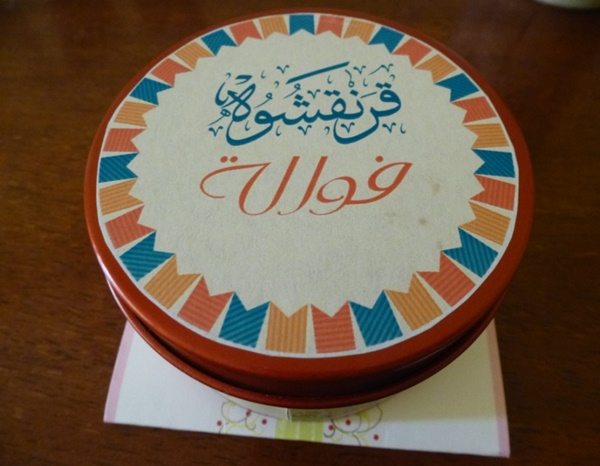
One notable celebration during Ramadan in Oman is the fifteenth day, referred to by the Omanis as Karankashu. In the evening the children dress up in traditional clothes and ask for sweets from their neighbours – much like trick or treating, but without the tricking and scary outfits! Some families host gatherings in their homes for this event, and the adults bring sweets and small amounts of money for the children. One of my teachers at the Arabic centre was kind enough to involve me in the festivities, and gave me a decorative tin with ‘Karankashu’ written in Arabic on the lid and filled with delicious chocolates – yet another moment that made me appreciate the opportunity to be in Oman for Ramadan, even if just for two weeks of it.
While my biggest regret is not staying for the whole of Ramadan and the three days that follow, a time of feasting and festivities called Eid, I don’t think my waistline would agree…
Photograph by Charlotte Darrell